OnOctober 20, the Ministry of Industry and Information Technology
(MIIT) of China issuedDocument No. 23 of 2022, approving 1,036 new
industry standards, includingHelium Purifiersand others. Among them,
the mechanical industry standards includefour energy efficiency limit
standards for air separation equipment, namely:
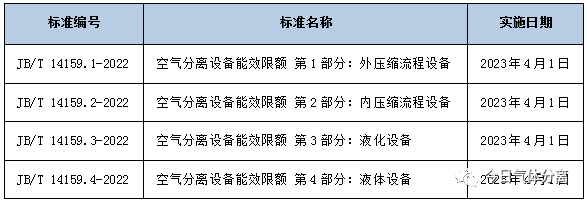
- Energy Efficiency Limits for Air Separation Equipment–Part 1: External Compression Process Equipment
- Energy Efficiency Limits for Air Separation Equipment–Part 2: Internal Compression Process Equipment
- Energy Efficiency Limits for Air Separation Equipment–Part 3: Liquefaction Equipment
- Energy Efficiency Limits for Air Separation Equipment–Part 4: Liquid Equipment
The
aforementioned four industry standards have been officially
promulgated and are scheduled to take effect onApril 1, 2023.
Part 1: External Compression Process Equipment (JB/T 14159.1-2022)
This standard specifies the energy consumption calculation methods and
comprehensive unit energy efficiency limits for medium-to-large external
compression ASUs producing oxygen with purity ≥99.6%, nitrogen with oxygen content≤10⁻⁵ (volume fraction), and argon with oxygen content ≤1.5×10⁻⁶ and nitrogen content ≤4×10⁻⁶ (volume fraction). It applies to cryogenic air separation equipment using
external compression processes, including self-pressurized oxygen compression
with outlet oxygen pressure of 40–55 kPa.
This
standard applies to external compression air separation units that utilize
cryogenic air separation methods to produce oxygen and nitrogen-based air
separation products.
Part 2: Internal Compression Process Equipment
(JB/T 14159.2-2022)
This standard specifies energy consumption calculation methods and unit product
energy efficiency limits for internal compression ASUs producing oxygen with
purity ≥99.6%, nitrogen with oxygen
content≤10⁻⁵, and argon with oxygen ≤1.5×10⁻⁶ and nitrogen ≤4×10⁻⁶.
It applies
to cryogenic ASUs with oxygen (gas + liquid) production ≥10,000 m³/h, where oxygen is pressurized
using a liquid oxygen pump and reheated to gaseous form, and processes employ
air or nitrogen booster flows.
Part 3: Liquefaction Equipment (JB/T 14159.3-2022)
This standard specifies the calculation methods for oxygen/nitrogen
liquefaction energy consumption and the energy efficiency classification of
liquefaction units, where the feed oxygen purity is ≥99.6% and feed nitrogen oxygen content≤10⁻⁵.
It applies
to liquefaction equipment producing liquid nitrogen or liquid oxygen using
nitrogen as the circulating refrigerant, equipped with at least one cryogenic
turbine expander. Applicable product streams include:
- 5–10 kPa low-pressure gaseous
nitrogen and 0.8–2.5 MPa medium-pressure nitrogen
for liquid nitrogen production.
- 10–45 kPa low-pressure oxygen
and 0.8–2.5 MPa medium-pressure oxygen for liquid
oxygen production.
Other types of liquefaction equipment may refer to this standard.
Part 4: Liquid Equipment (JB/T 14159.4-2022)
This standard specifies energy consumption calculation methods and unit energy
efficiency limits for liquid ASU products, with oxygen purity ≥99.6%, nitrogen with oxygen content≤10⁻⁵, and argon with oxygen ≤1.5×10⁻⁶ and nitrogen ≤4×10⁻⁶.
It applies to liquid ASUs
with equivalent liquid product output ≥1,000 m³/h, where liquid products
account for≥50% of total output, produced using
cryogenic methods.